Maris Lecture 2026: Oborevwori Rallies Citizens’ Active Participation In Tackling Insecurity As Irabor Blames Unresolved Political Crises
Amid Nigeria’s deepening security crisis, Delta State Governor, Sheriff Oborevwori, has issued a stark warning that government alone could no longer shoulder the responsibilities.
Speaking at the 2026 Maris Annual Public Service Lecture in Asaba, the governor described insecurity as an existential threat to national unity, insisting that collective vigilance and cooperation between citizens and security agencies are now indispensable.
The Maris Annual Public Service Lecture series, a platform to proffer solutions to identified societal challenges holds every Wednesday before Easter Sunday.
Represented by the Commissioner for Basic and Secondary Education, Dr Kingsley Ashibuogwu, the governor painted a grim picture of the country’s persistent insurgency.
“Security is no longer the exclusive preserve of government,” he stressed, saying there is a need for community-based policing and citizen intelligence as part of a broader security architecture.
The governor highlighted his administration’s investments in operational support for security agencies.
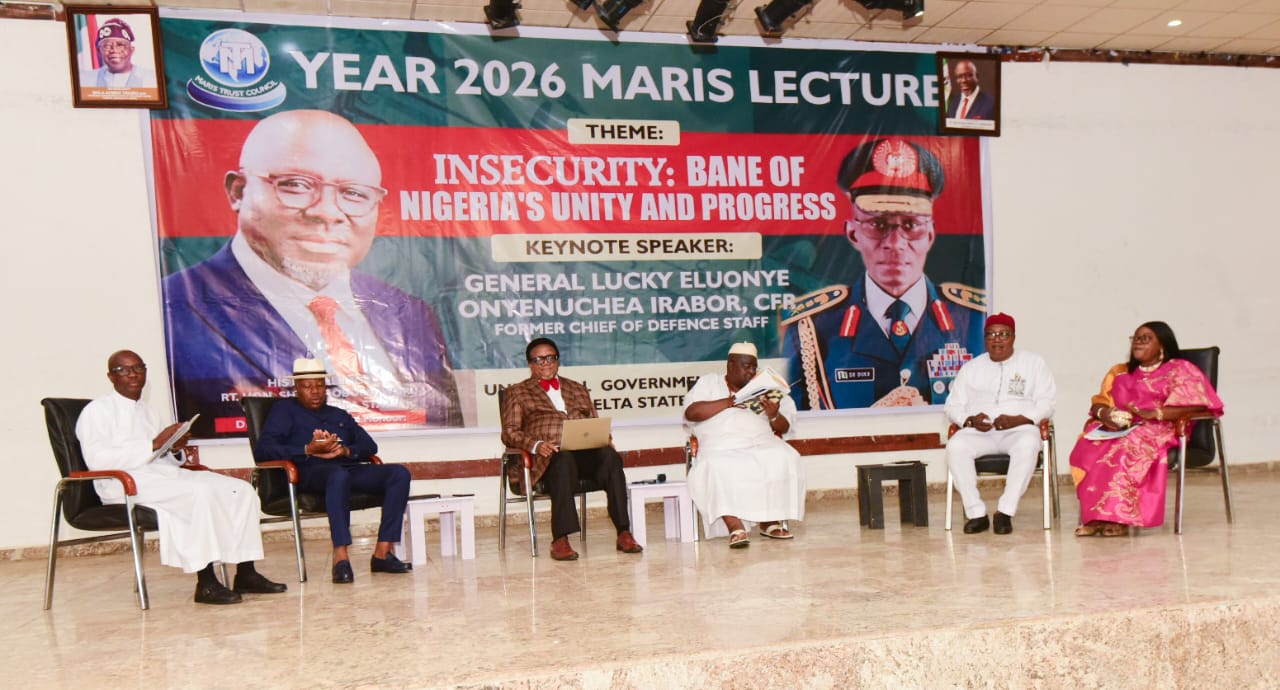
The lecture, themed: ‘Insecurity: The Bane of Nigeria’s Unity and Progress’, brought together policymakers, scholars, and security experts, many of whom echoed concerns that Nigeria’s crisis has outgrown conventional responses.
In a keynote address, former Chief of Defence Staff, Lucky Onyenuchea Irabor, delivered a more structural critique, describing insecurity as the single greatest threat to Nigeria’s survival.
Irabor argued that the roots of the crisis lie far deeper than criminality, pointing instead to unresolved political grievances and historical divisions that have festered for decades.
He called for the institutionalisation of a national reconciliation policy, stressing that without deliberate efforts to heal longstanding wounds, security interventions would remain unsustainable.
He emphasized that insecurity has greatly impacted Nigeria’s unity and progress, the two most precious aspirations of the country.
According to him, Nigeria’s federal character was designed to manage diversity, yet insecurity has deepened the outward-pulling forces. Insecurity strikes at two of Nigeria’s most precious aspirations: unity and progress.
“Separatist rhetoric in the South-East, farmer-herder clashes that pit North against South, and resource-control grievances in the Niger Delta have all intensified.
“When citizens in one zone live in perpetual fear while others appear insulated, the social contract frays. National integration, that elusive sense of “oneness”, becomes performative rather than substantive”.
The former chief of defence staff noted that the country has not made reasonable progress since 2015 due to insecurity from the different parts of the country.
He said: “On progress, the damage is unquantifiable and devastating for the Sustainable Development Goals (SDGs).
“Nigeria’s third Voluntary National Review, a country-led, voluntary process where UN member states assess and present their progress in achieving the seventeen Sustainable Development Goals (SDGs), revealed progress in only 34.6 per cent of key indicators; stagnation or regression marks the rest.
“Food insecurity has doubled since 2015, reaching 69.7 per cent of the population. SDG 1 (No Poverty) and SDG 2 (Zero Hunger) are in retreat precisely because farmers are displaced and markets are unsafe.
“The SDG 8 (Decent Work and Economic Growth) suffers as foreign direct investment flees – that is capital that would otherwise fund infrastructure, skills, and innovation.
“The SDG 16 (Peace, Justice and Strong Institutions) is both cause and casualty: without security, every other goal cannot be achieved”.
He thanked thanked the organisers of the lecture for providing a platform that encouraged debate and knowledge sharing.
“I am so grateful to God for Maris Trust Council and their Annual Public Service Lecture series.
“This lecture series has become a platform that encourages rigorous public debate and discourse leading to the distillation of the best ideas and knowledge.
Irabor, however, recommended that government should enhance coordination of response agencies by ensuring deployment of technology-enhanced surveillance.
“Expand social protection programmes in vulnerable regions to reduce recruitment into criminal networks. Reform policing systems with training, equipment, welfare, and accountability improvements.
“Promote civic education and inclusive governance to strengthen national cohesion. Create a forum for national reconciliation among the federating entities and arrest the growing drift in moral values among youths through inclusive economic empowerment models, among others,” he advised.
Earlier, the Chairman of the occasion, former Chief of Naval Staff, Admiral Dele Ezeoba (rtd), in his opening remarks lauded the Council for sustaining the annual lecture in honour of late Stella Maris Egugbo.
He acknowledged that the series had come with various topics that had contributed to intellectual discusse to as part of effort to address the country’s challenge, saying that the year’s theme was apt and to be delivered by an intellectual, Gen. Irabor.
He noted that the essence of governance was to ensure security of life and property, adding that “security is everybody’s business to ensure safety as insecurity is absence of security”.
He expressed confidence on the keynote speaker, Gen. Irabor, while urging the discussants to explore the lecture and and proffer solutions to the current situation.
He said that government should therefore provide a level environment that allowed for free enterprise and people’s liberty of movement, adding that when that was absent, there would be a fundamental problem.
In his remarks, the Secretary to the State Government (SSG), Dr Kingsley Emu, lauded the speaker, Gen. Irabor and the Chairman, Admiral Ezeoba for their contributions and recommendations as solutions to insecurity in the country.
He, however, noted that the choices the youths make today exacerbate insecurity, adding that there was need to re-orientate the youths to understand that there has always been hardship.
He said that the state government has put mechanism in place and making efforts to accommodate, and educate the youths through various platforms including agric, commerce and various empowerment programmes which has helped significantly.
The discussants, former Director, DSS, Mr Mike Ejiofor, Prof. Hope Eghagha, Mr Friday Warri, Rev.Fr. John Konyeke, Dr Rosemary Ogabu and Prof. Kemi Emina, the moderator, deliberated on the lecture and raised concerns and defined the roles of government and other stakeholders.
On his part, Mr Fidelis Egugbo, Secretary, Maris Trust Council and the Senior Special Assistant (Media) to Governor Sheriff Oborevwori, thanked all for supporting the council, stating that the lecture can only be sustained with the support by relevant stakeholders.
Some of those who attended the lecture include Gen. Mike Ndubisi who represented Rear Admiral Mike Onah as Father of the Day, Dame Princess Minnie Igbrude (Mother of the Day), Dr. (Mrs.) Mininim Oseji, Head of Service (HOS), Delta State, Phar. Dr. Paul Enebeli and his son, Chukwudi Enebeli, SAN, Hon. Uche Uraih, Ph.D., and his wife, Patricia, Hon. (Barr.) Sam Osasa, the Executive Secretary, Delta State Security Trust Fund, Sir Patrick Ejidoh, Mrs Florence Omoni Johnson, Dr. Festus Okubur, Rev. Fr. Andrew Mozia of the Catholic Mass Centre, Maris Schools, Okpanam, Hon. Anthony Chukwu, Pastor Chuks Agidigbo, top government officials, journalists led by Comrade Churchill Oyowe, Chairman, Nigeria Union of Journalists, NUJ Chapter, members of EXCOF led by Mr Sunny Edoge, Mr Dennis Media, Greg Ejohwomu, the civil societies, security experts, the Egugbos, among others from different walks of life.